
Regulatory Guidance
IFSCA Digital Accessibility Audit Readiness Guide
A practical accessibility audit preparation guide for IFSC digital services, with careful distinctions between IFSCA disclosures, WCAG testing, evidence, and remediation.
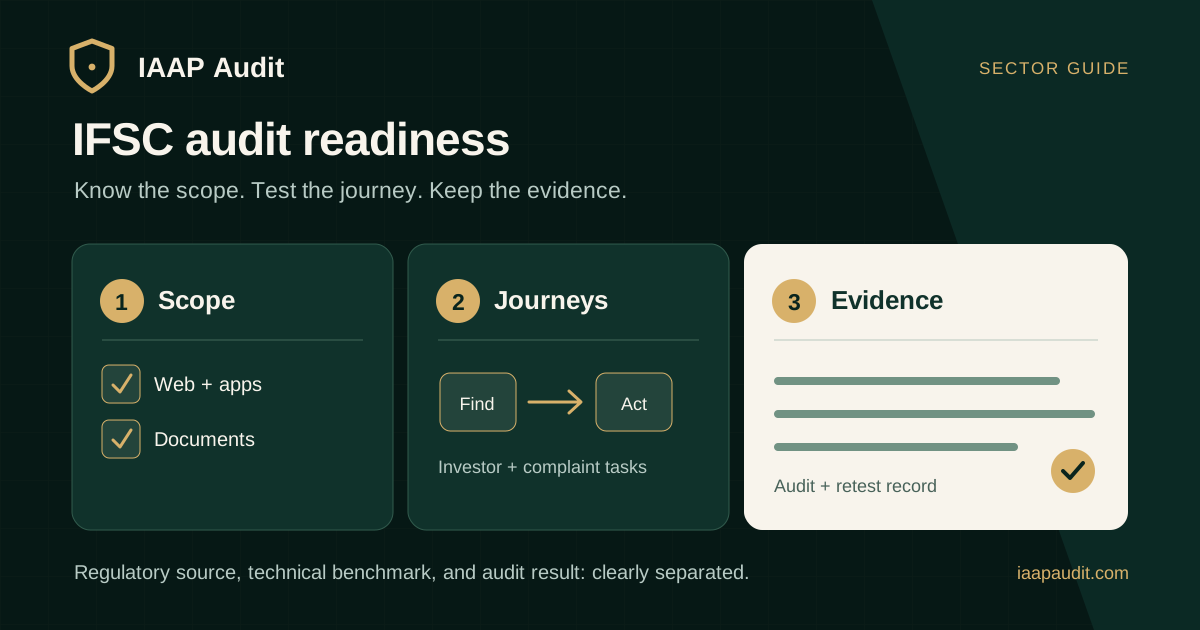
Quick answer: how should an IFSC entity prepare for a digital accessibility audit?
Start with the websites, web applications, mobile apps, portals, and documents that customers and investors use. Identify the entity's IFSCA category and the specific publications and journeys it owns. Agree a technical audit benchmark, such as Web Content Accessibility Guidelines (WCAG) 2.2 Level AA where appropriate, then test representative tasks with automated and manual methods. Record findings, ownership, remediation, and a retest plan.
This is an audit-readiness approach, not a claim that IFSCA has issued one universal WCAG audit circular for all regulated entities. The obligations that apply to an organization depend on its activity, registration, and current directions.
What do the cited IFSCA circulars actually require?
On August 26, 2026, the International Financial Services Centres Authority (IFSCA) issued a circular requiring fund management entities (FMEs) registered under its Fund Management Regulations, 2025 to maintain a website or webpage in the specified manner. It distinguishes the options for authorised and non-retail FMEs from the independent-website requirement for registered retail FMEs. The circular states that it comes into force on December 1, 2026, and gives a December 1, 2026 deadline to intimate the website or webpage URL to IFSCA for existing FMEs.
The circular calls for specified information to be publicly available without registration or login and, where a group site hosts the page, for a conspicuous link from its home page. It lists profiles, contacts, relevant scheme or fund information, grievance details, and other disclosures, with additional items for retail schemes. These are publication and discoverability directions. In that circular, the words publicly accessible and accessible through a link should not be presented as an explicit WCAG conformance requirement.
IFSCA's December 2, 2024 complaint-handling circular applies to the regulated entities specified in its applicability clause, subject to listed exclusions. It requires the complaint policy and officer contacts to be prominently disclosed on a website or dedicated group webpage. The circular came into force on January 15, 2025. Check the entity's actual status before treating it as applicable.
Is an IFSCA WCAG audit or SEBI submission mandated by those circulars?
The two IFSCA circulars cited here do not prescribe a WCAG version, a universal accessibility-audit filing, or SEBI Table C3 and C4 submissions. SEBI's framework belongs to SEBI-regulated entities and should not be copied into an IFSCA plan without a separate legal basis.
An accessibility audit remains a practical way to evaluate whether digital information and tasks are usable by people with disabilities. Set out the chosen WCAG version and level in the engagement scope, and ask the entity's compliance team to confirm any additional IFSCA, contractual, or legal requirements that apply to its services.
Which digital assets belong in the scope?
Build an inventory from the customer's perspective. The public website is one part of it; logins, account dashboards, application forms, fund information, disclosures, downloadable documents, and complaint routes can matter more to task completion. Include third-party components where the entity relies on them for a user journey, and record the limits of access or testing ownership.
For an FME, the August 2026 circular's publication list is a useful starting point for prioritizing pages and documents. It does not itself define the technical accessibility test.
- Public profile, contact information, fund and scheme pages, and links from any group website.
- Investor documents, scheme information documents, key information documents, and other downloadable disclosures where applicable.
- Onboarding, account access, KYC, servicing, transaction, and support journeys the entity offers digitally.
- Complaint policy, grievance contact information, submission paths, acknowledgement, and follow-up states where applicable.
- Mobile app screens, embedded content, identity checks, and documents generated by the service.
Which user tasks should be tested first?
Prioritize tasks where a barrier prevents access to a financial service or required information. A user may need to find scheme documents, understand a fee, complete an application, verify identity, contact the grievance officer, or track a complaint. If a task is only tested as a static page, critical states can be missed.
Test from discovery through completion: landing page to disclosure, login to decision, or complaint entry to confirmation. Include desktop and mobile views, keyboard operation, screen-reader checks, zoom, form errors, and downloadable document usability where relevant.
- Find the entity's IFSC registration and current contact details.
- Locate a fund document and read its headings, tables, and links.
- Complete an application or identity step without relying on a single sensory or input method.
- Find grievance information, submit a complaint, and understand the confirmation.
- Read the same essential information at a narrow viewport and under magnification.
How should WCAG be used as an audit benchmark?
WCAG provides testable success criteria for web content. A scope can specify WCAG 2.2 Level AA, the platforms and document formats included, the technologies tested, and how findings will be mapped. Record any additional standard or procurement requirement separately rather than implying it came from the cited IFSCA circulars.
A serious audit combines automated checks with manual review. Automated scans can flag some missing labels or contrast problems; they cannot determine whether an investor can complete a multi-step journey or understand a complex disclosure. Keyboard, assistive technology, and document tests provide the evidence behind the conclusion.
What should the report and evidence package contain?
The report should let product, content, compliance, and engineering teams act on the same record. Separate technical accessibility findings from regulatory publication checks. A missing grievance-officer contact is a content or regulatory issue; an unreachable contact link is an accessibility problem. A page may have both, but each needs its own evidence and owner.
Do not describe a scan percentage as a statement that the entity is compliant. State the tested scope and limitations, the relevant WCAG criteria, affected journeys, and what remains open after retesting.
- Scope register covering URLs, screens, documents, languages, states, and exclusions.
- Methods, browser and assistive technology combinations, and tested dates.
- Finding ID, reproduction steps, screenshot or recording, user impact, severity, and WCAG mapping.
- Publication or disclosure inventory with the applicable source direction identified separately.
- Assigned remediation owner, fix guidance, and retest result for each finding.
How should teams handle remediation and retesting?
Fix shared patterns first when they block many pages, such as navigation, forms, document templates, or authentication controls. Keep the finding and its original reproduction route tied to the remediation ticket. Verify content changes on the published page as well as code changes in the application.
Retest the original task and a representative sample of pages that reuse the affected component. Record whether the issue is resolved, partly resolved, or still open, with dates and evidence. If the website or document library is being rebuilt for the December 2026 FME publication date, plan a final accessibility review of the actual released content.
Common questions for IFSC audit buyers
Does IFSCA's word accessible in the FME website circular mean WCAG conformance? In the cited clauses it describes public availability and a link from a group homepage. The circular does not specify a WCAG version or level.
Should every IFSC entity use SEBI Table C3 or C4? No. Those are SEBI submission tables and should not be treated as IFSCA forms without an applicable instruction.
Does a document inventory replace PDF testing? No. Confirm that key documents can be navigated and understood, including structure, reading order, links, and meaningful alternatives where appropriate.
When should an audit happen? Allow enough time to remediate and retest the published experience. For a specific filing or publication deadline, first verify the current direction that applies to the entity.
Official references and scope note
IFSCA circular dated August 26, 2026, Requirement for Fund Management Entities to Maintain a Website or Webpage: https://ifsca.gov.in/Common/PreviewPdf?fileName=Circular_Requirement_for_Fund_Management_Entities__FMEs__to_maintain_a_website_or_webpage_26_Aug_2026_20260827_0806.pdf&id=b64bc220b28b988fb41d0459994ee804
IFSCA circular dated December 2, 2024, Complaint Handling and Grievance Redressal by Regulated Entities in the IFSC: https://www.ifsca.gov.in/Document/Legal/complaint-handling-and-grievance-redressal-by-regulated-entities-in-the-ifsc02122024015438.pdf
W3C Web Content Accessibility Guidelines 2.2: https://www.w3.org/TR/WCAG22/
This guide describes audit preparation using the cited sources as of October 22, 2026. It does not determine whether another direction applies to a particular regulated entity.
Prepare an evidence-led accessibility review
Bring the entity category, current directions, platform inventory, key user journeys, sample documents, test accounts, and publication plans into one scope discussion. That makes it possible to plan a review around the real service instead of an incomplete list of pages.
IAAP Audit can assess the scoped digital experience against an agreed accessibility benchmark, document actionable findings, and retest the published journeys after remediation.