
Procurement
Section 508 vs WCAG: What Procurement Teams Should Know
A practical guide for procurement and compliance teams comparing Section 508 and WCAG, with vendor evidence, ACR/VPAT review, testing, remediation, and ICT accessibility risk.
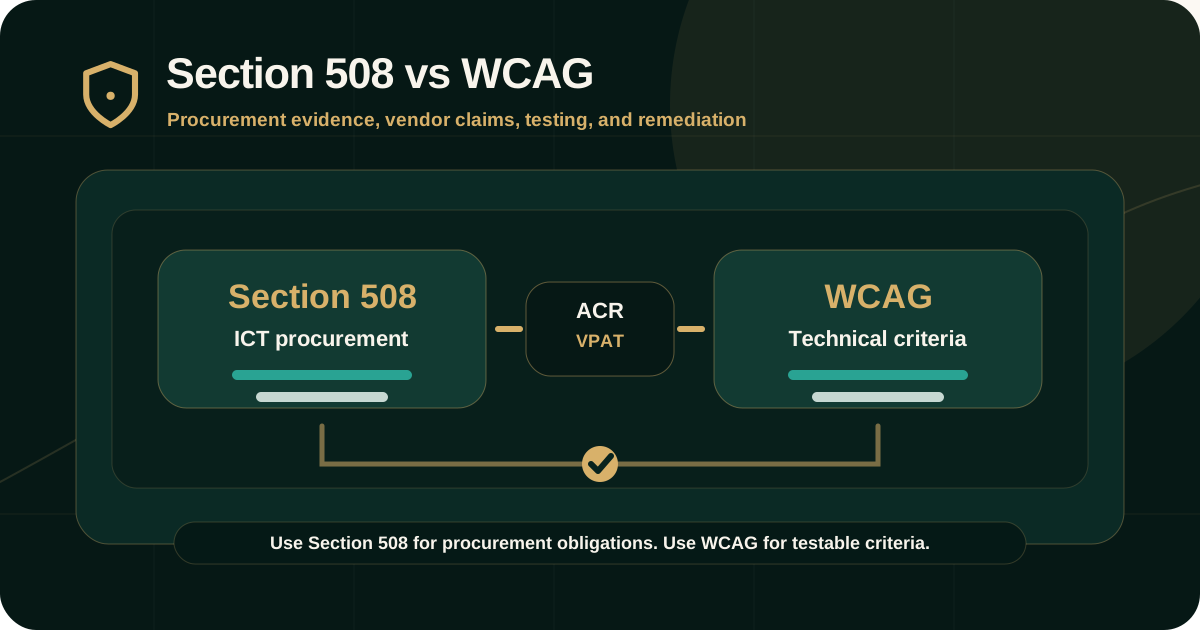
Quick answer: how are Section 508 and WCAG different?
Section 508 is a U.S. federal accessibility requirement that applies when federal agencies develop, procure, maintain, or use information and communication technology. WCAG, the Web Content Accessibility Guidelines, is a technical accessibility standard developed by W3C.
For procurement teams, Section 508 defines the legal and acquisition context. WCAG helps define technical accessibility criteria that can be tested, evidenced, remediated, and retested.
What Section 508 means for procurement
Section508.gov explains that Section 508 requires federal agencies to make electronic and information technology accessible to people with disabilities and applies when agencies develop, procure, maintain, or use that technology.
The procurement impact is direct. Accessibility cannot be left until after purchase or deployment. Section 508 requirements should be included from the beginning of the ICT procurement lifecycle and carried through development, testing, and acceptance.
- Define applicable accessibility requirements before solicitation.
- Include Section 508 requirements in requirements documents and contract language.
- Request vendor accessibility evidence before award.
- Evaluate proposals against stated accessibility requirements.
- Validate vendor claims before deployment or acceptance.
- Track remediation and exceptions where products do not fully conform.
What WCAG means in this context
WCAG is a W3C standard that explains how to make web content more accessible to people with disabilities. The revised Section 508 standards harmonized with WCAG 2.0, and Section508.gov procurement guidance refers to WCAG 2.0 A and AA criteria for development and testing of software, websites, documents, multimedia, applications, and other applicable ICT.
For procurement teams, WCAG gives technical criteria that can be used in accessibility evaluation. But WCAG alone does not replace procurement planning, contract requirements, vendor evidence review, exceptions analysis, or acceptance testing.
- WCAG provides technical accessibility criteria.
- Section 508 provides the federal ICT accessibility requirement and procurement context.
- Revised Section 508 uses WCAG 2.0 A and AA criteria in relevant ICT testing contexts.
- Some organizations may also use WCAG 2.1 or WCAG 2.2 as a stronger internal or contractual target.
- The contract and audit scope should state the target clearly.
ACR and VPAT evidence
Section508.gov procurement guidance tells buyers to request Accessibility Conformance Reports, often created using the VPAT template, or other evidence of accessibility testing. These documents can help compare vendor claims, but they should not be accepted blindly.
An ACR or VPAT should be reviewed against the actual ICT being purchased, including product version, features, configuration, user roles, documents, integrations, and known exceptions.
- Confirm the product name, version, model, and scope.
- Check which standards are reported and which are not applicable.
- Look for unsupported claims such as broad support without evidence.
- Review exceptions, remarks, and partially supported items.
- Ask for testing methodology, date, evaluator, environment, and known limitations.
- Require remediation plans for important gaps.
Vendor claims should be validated
Section508.gov states that proposals should be evaluated to validate vendor claims against accessibility requirements, and that hands-on testing using a repeatable, systematic testing methodology is needed to validate full conformance.
For procurement teams, this means vendor documentation is an input, not the final decision. The higher the risk of the ICT, the more important independent testing, sample validation, remediation commitments, and acceptance criteria become.
- Validate critical workflows before acceptance.
- Test configured or customized implementations, not only generic product demos.
- Review documents, media, user support, and admin interfaces when they are in scope.
- Use manual testing for issues that automation cannot confirm.
- Define who performs testing and when it happens.
- Keep evidence for acceptance, remediation, and risk decisions.
Key differences procurement teams should remember
Section 508 and WCAG should not be treated as interchangeable terms. They are related, but they serve different roles in procurement and evaluation.
A strong procurement process uses both correctly.
- Section 508: U.S. federal requirement for accessible ICT in agency development, procurement, maintenance, and use.
- WCAG: technical standard for web content accessibility and related testing criteria.
- Section 508 scope: ICT products and services, including software, websites, documents, multimedia, applications, and other applicable technology.
- WCAG scope: web content, with related use in non-web ICT through standards and guidance.
- Procurement evidence: ACRs, VPATs, testing plans, vendor evidence, exceptions, remediation commitments, and acceptance testing.
- Audit evidence: findings, user impact, standards mapping, screenshots, keyboard paths, screen reader notes, document checks, and retest results.
What to include in solicitation and contract requirements
Procurement teams should avoid vague accessibility language. The solicitation should identify applicable Section 508 requirements, accessibility testing expectations, vendor evidence requirements, remediation obligations, and acceptance criteria.
This reduces the risk of buying technology that cannot be used effectively by employees or members of the public with disabilities.
- Applicable Section 508 standards and exceptions, if any.
- Required ACR or VPAT format and current product version.
- Testing plan and responsible testing party.
- Acceptance criteria for accessibility verification.
- Remediation timelines and responsibility for defects.
- Requirements for accessible documents, support materials, training, and updates.
- Right to request accessibility testing evidence before acceptance.
How audits support procurement decisions
An accessibility audit can support procurement by checking whether vendor claims match real product behavior. This is especially useful for high-risk ICT such as public portals, employee systems, learning platforms, case management tools, financial systems, healthcare platforms, and document-heavy workflows.
The audit should test the product as it will actually be used, including configuration, custom workflows, roles, documents, integrations, and supported devices where relevant.
- Pre-award evaluation of shortlisted vendors.
- Post-award acceptance testing before deployment.
- Independent review of ACR or VPAT claims.
- Testing of configured or customized implementations.
- Remediation verification after vendor fixes.
- Evidence package for governance and risk review.
Common procurement mistakes
Accessibility procurement problems usually start when teams treat accessibility as a document exercise instead of a verification process.
The safest procurement approach is to require evidence and testing, not just statements.
- Accepting a vendor's ACR or VPAT without reviewing scope and remarks.
- Forgetting to include Section 508 requirements in the solicitation.
- Testing only a demo instead of the configured product.
- Ignoring documents, admin screens, support content, or training materials.
- Assuming WCAG language alone covers all Section 508 procurement obligations.
- Accepting delivery without remediation evidence or retest results.
Practical recommendation
Use Section 508 to define procurement obligations and use WCAG to support technical accessibility evaluation where applicable. Do not rely only on vendor claims. Request ACR or VPAT evidence, review it carefully, validate critical workflows, and require remediation and retesting before acceptance.
For procurement-sensitive ICT, an evidence-led accessibility audit can help buyers compare vendors, reduce delivery risk, and avoid accessibility problems after deployment.
Official references used
Section508.gov IT Accessibility Laws and Policies: https://www.section508.gov/manage/laws-and-policies/
Section508.gov Buy Accessible Products and Services: https://www.section508.gov/buy/
U.S. Access Board Revised 508 Standards: https://www.access-board.gov/ict/
W3C WCAG Overview: https://www.w3.org/WAI/standards-guidelines/wcag/
W3C WCAG 2.2 Recommendation: https://www.w3.org/TR/WCAG22/